
On this page
- Why soils matter here
- Slopes and critical areas
- How roof water reaches the foundation
- Typical local problems
- Discharge options, best to least
- Grading
- Tightlines done right
- When to bring in others
- Checklist
- Foundation drainage: short answers
- Foundation drainage around Renton: where it matters most
- A tip before anyone gets on a ladder
Why soils matter here
Regional drainage guidance from Snohomish County describes glacial till, commonly called hardpan, as a very dense soil of clay, silt, sand, gravel and boulders that can lie anywhere from inches to several feet below the surface. The Puget Sound lowland was shaped by the same ice sheets, and much of the higher ground around Renton, the plateaus of the Highlands, Benson Hill, Fairwood and the East Renton Highlands, sits on similar glacial deposits.
On that ground, roof water does not simply soak away. It soaks into the looser topsoil, reaches the dense layer and travels along it, often straight toward the nearest foundation wall, crawl space or basement.
Slopes and critical areas
Renton is a city of slopes, from the bluffs above Lake Washington in Kennydale to the hillsides along the Cedar River valley and Talbot Hill. Renton's permit FAQ treats landslide hazard areas as critical areas where work needs a permit. During the December 2025 atmospheric river, saturated ground slid onto Maple Valley Highway, according to the Kent Reporter. Concentrating a roof's worth of water at the top of a bank is exactly what to avoid.
How roof water reaches the foundation
- Rain falls on the roof, often for days at a time in winter.
- Gutters collect it and send it to a handful of downspouts.
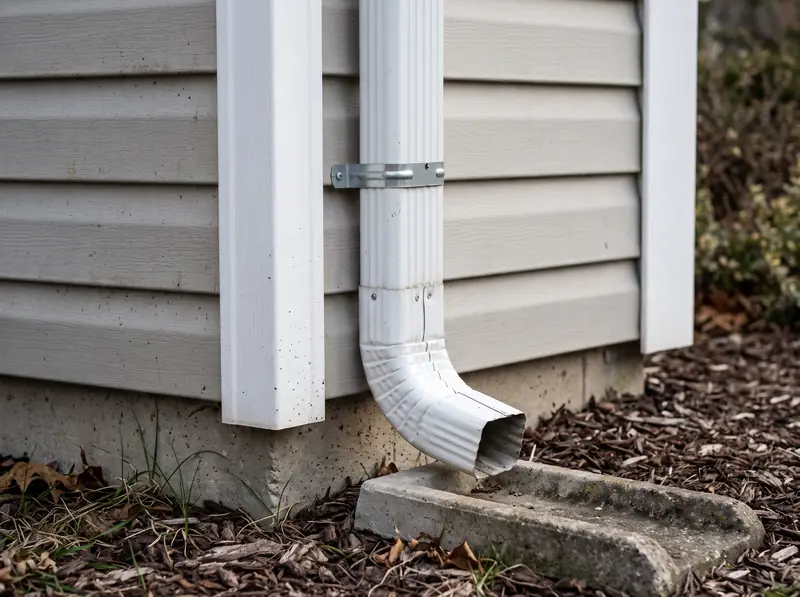
- Each downspout releases a concentrated stream.
- If that stream lands beside the wall, the topsoil there stays saturated.
- Over dense till, the water moves sideways toward the foundation and crawl space.
- Weeks of this through a wet season mean damp crawl spaces, wet basement walls and settled steps.
A 1,000 square foot roof section shedding an inch of rain sends over 600 gallons to its downspouts. In a November averaging 6.31 inches at Sea-Tac, per the normals, that is several thousand gallons from one section of roof in a month.
Typical local problems
| Symptom | Likely roof-water cause |
|---|---|
| Damp crawl space or standing water under the house | Downspouts discharging at the foundation |
| Wet basement wall at one corner | Downspout or overflow at that corner |
| Soil washed out beside the house | Overflow or a missing extension |
| Settled stoop or patio | Repeated soaking of soil beneath |
| Soft or slumping ground on a slope below the house | Downspouts emptying at the top of the bank |
Discharge options, best to least
| Option | On dense soil and slopes |
|---|---|
| Tightline (solid buried pipe) to an approved outlet | Best where allowed |
| Long extension onto a splash block, ground sloping away | Good on gentle lots |
| Rain barrel with overflow piped away | Useful in summer; overflow must go somewhere sensible |
| Rain garden on flat ground far from the house and any slope | Works where soils drain |
| Short extension | Better than nothing |
| Dry well or infiltration trench | Poor over hardpan |
| Discharge at the wall or at the top of a slope | Worst |
Grading
Soil should slope away from the house, falling several inches in the first 10 feet. Beds built up against the wall, settled backfill and patios tilted toward the house send water back. Gutter work and grading work together.
Tightlines done right
- Solid pipe, not perforated, near the house.
- Steady fall to the outlet.
- A cleanout at the downspout.
- A leaf strainer at the top to keep needles and moss out.
- An outlet that is allowed by the city or county, not onto a neighbor's land or a slope.
When to bring in others
Gutter contractors handle roof water. Persistent leaks, wide cracks or movement call for a waterproofing contractor or structural engineer, and hillside drainage may call for a geotechnical engineer.
Checklist
- Every downspout discharges at least several feet away.
- No downspout empties at the top of a slope.
- Ground falls away from the house.
- No downspouts empty beside crawl space vents or onto patios.
- Gutters do not overflow in ordinary rain.
- Buried lines run clear and cleanouts are accessible.
Foundation drainage: short answers
| Question | Answer |
|---|---|
| Do I need a sump pump? | That is a waterproofing question; start by fixing roof water. |
| Can gutters cause foundation cracks? | Poor discharge can contribute to settlement and movement. |
| Should downspouts go to the street? | Only where allowed and practical. |
| Is regrading expensive? | Small regrading near the house is often modest. |
Foundation drainage around Renton: where it matters most
| Area | Why it comes up there |
|---|---|
| The Highlands | Crawl-space houses |
| Kennydale | Slopes toward the lake |
| Talbot Hill | Hillside lots |
| Skyway | Small houses on a hill |
A tip before anyone gets on a ladder
After a wet week, walk round the house and note any spot where water stands near the walls or soil has washed out. Photograph each one with the nearest downspout in frame.